


|
|
The recovery |

The part of the rowing motion where the blade is above the water is also called the “recovery”. The recovery starts at the rest point, somewhere between fixed seat and ¼ seat. This point is both the start and end point of the stroke. Muscles that are not being used are relaxed. The shoulders are low, that is, they are not hunched up. The arms are straight and the rower is sufficiently bent in.

Slowly and steadily (i.e. at one speed) is slided to the catch. At the catch, the lower legs are vertical (no further) and the chest may touch the legs. During the sliding, the angle of the trunk to the boat does not change. Immediately after the knees, the blade gently squares, with a constant movement. The ratio between draw and recovery is between 1:1.1 and 1:1.5. So the recovery takes 10% to 50% longer than the draw.
The Australian recovery
In recent years, rowing with a  pause at the
 finish has become a familiar sight on the rowing waters. The decision whether to use this recovery is a fundamental decision.
It is important to realize, however, that the Australian recovery only differs from the recommended stroke in how the recovery is performed during training sessions. At race pace, both recoveries look identical, regardless of whether training is done with or without pauses. At the 2018 World Championships in Plovdiv, for instance, the Australian and American men's eights trained side by side the day before the race. The Australians paused for nearly a second at the finish, unlike the Americans. When they raced each other in the first heat, they finished neck and neck, both clocking 5:19. It is therefore certainly not a racing issue, but a training consideration.
| If you decide to row with this recovery, it is important to execute it correctly: | |
| 1. | The pause is made at the finish, where the handle(s) is/are brought in an arc towards the body (see drawing below). This prevents  feathering early or washing out (see drawing below). |
| 2. | The rowers anticipate the moment the recovery begins; otherwise, they will be too late. |
| 3. | The sliding speed is higher than in the recovery recommended by the roei.app. |
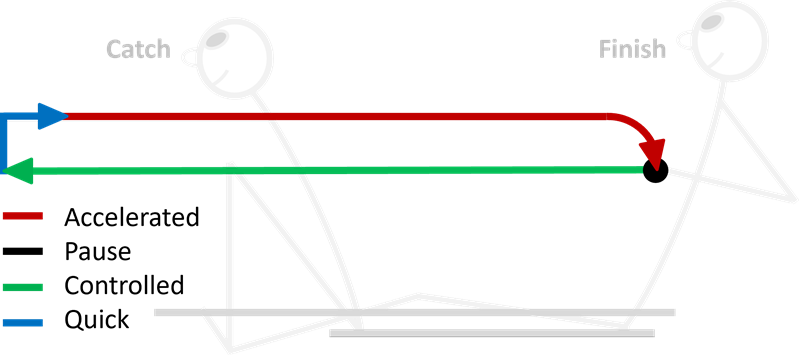
The Australian recovery with pause, correctly executed
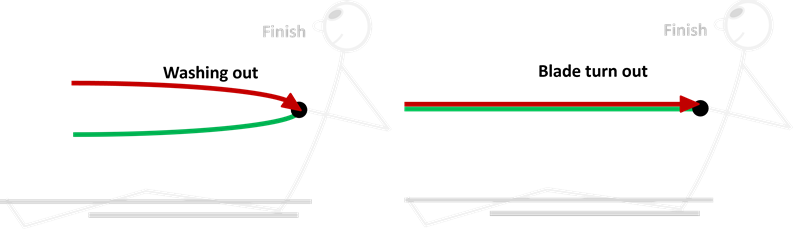
The Australian recovery with pause, incorrectly executed
Related faults and drills


 |
Hands |
 |
Catch |
This article was translated automatically and is provided to you for free. You are most welcome to improve it!