


|
|
The finish |

End draw, release and initial away cannot be separated from each other. It happens in one fluid motion. The initial away is done with trunk and arms at the same time (modern initial away) and the rower sits somewhere between fixed slide and ¼ seat fully bent in and with arms outstretched ready to move up the slide.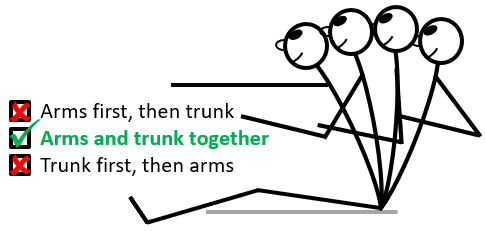
Near the trunk, the handle(s) is/are pressed down from the elbows with a short push. To prevent the handle(s) from reaching the lap, this downward push is cushioned with a horizontal initial away. In this turn, the feathering is performed (push down, turn and push away).
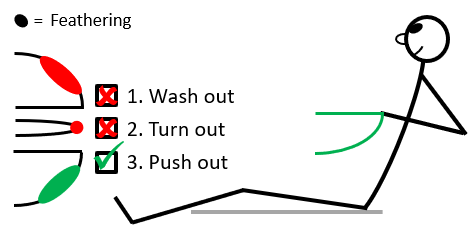
When  Washing out, the handle(s) are pulled to the hips, causing the blade slowly run out of the water. When Turned out, the blade(s) is/are turned out of the water and there is no difference between the draw and away height. Both should be avoided.
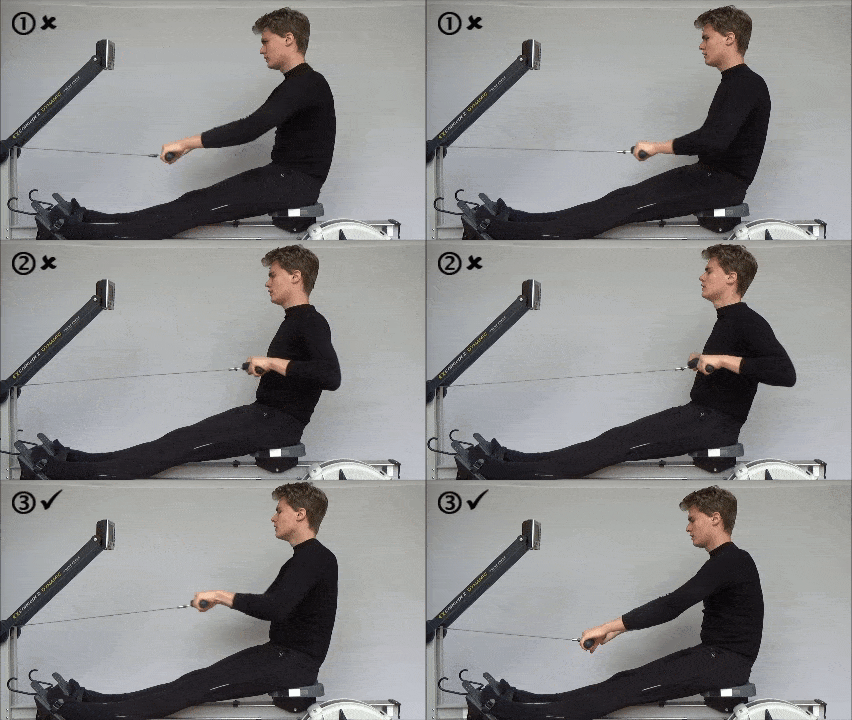
Avoid washing out (1), turning out (2) and be sure to push out (3)
Related faults and drills


 |
Draw |
 |
Balance |
This article was translated automatically and is provided to you for free. You are most welcome to improve it!