


|
|
Checking the course |

Checking the course properly does not happen automatically: too often it ruins the pleasure of rowing, and too little increases the risk of collision. Letting the boat run easy just to look around, significantly drops the average boat speed, which is counterproductive.
Situational awareness
It is crucial that a rower does not just look, but actively builds situational awareness:
- what is the boat's position on the waterway (canal, river, or channel);
- what are the proper steering lines;
- what obstacles and other boats are present, and which ones pose a potential hazard.
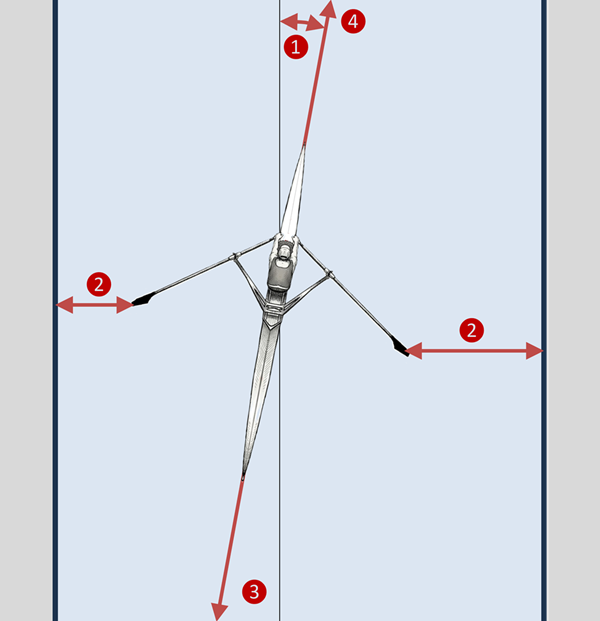
Checking 360 degrees around you is key to achieving this:
- When looking along the line of your stern, is the boat aligned straight with the waterway? Or is it at an angle?
- When looking sideways at the distance from your blades to the bank, are you on the port side, in the middle, or on the starboard side of the waterway?
- When looking far ahead over your shoulder, is the bow pointing toward where you want to go?
- Is the tip of your stern still pointing in the right direction? Once the bow is pointed exactly in the right direction, remember where the stern is pointing. As long as the stern remains pointed at that same landmark, the boat is bound to stay on course, as bow and stern are naturally aligned.
Looking around
Looking around correctly is done as follows:
- Turn your head sideways at the catch, so you are looking at least to the side and preferably diagonally backward.
- Rotate your torso at the finish/release, allowing you to look fully behind you.
- Ensure the handles do not stop moving, but continue their fluid motion.
- Do not look around exclusively over your preferred shoulder, as this prevents a complete overview. Make sure to look alternately over both shoulders. See also:
 Looking around drill
When looking, it is vital that the rower does not simply check if something is approaching. Looking around properly involves three steps:
- Build a 'mental map' of what lies ahead of the boat. Know what other obstacles and boats are present.
- Determine whether steering is necessary. If so, put the bow on the correct course and maintain it by aligning the stern with a fixed point in the landscape.
- Decide when you need to look around again.
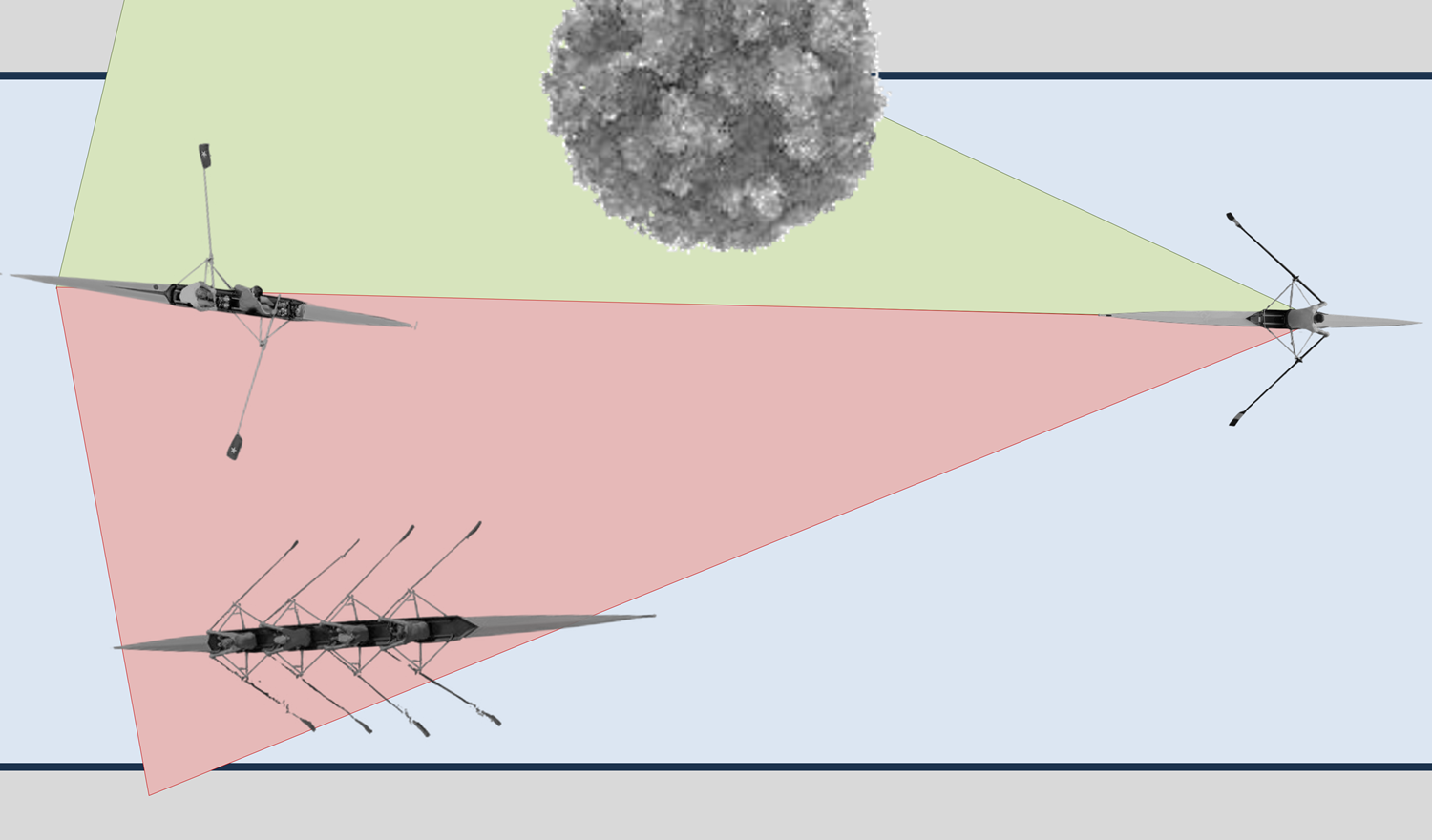
In the example above, the single sculler notices a tree, a double/pair, and a quad/four on the water. Their observations:
- The waterway does not curve: no action required.
- The tree is blocking the path: steer to port and maintain the new course using the stern.
- The double/pair is moving at the same speed in the same direction: no action required.
- The quad/four is moving toward the middle of the waterway: before reaching the tree, look over the right shoulder again to check if there is still sufficient room.
Mirrors
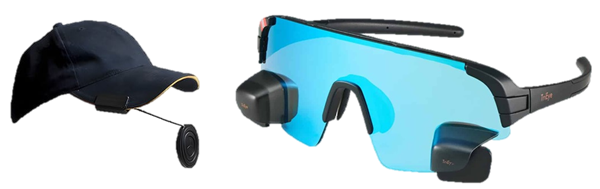
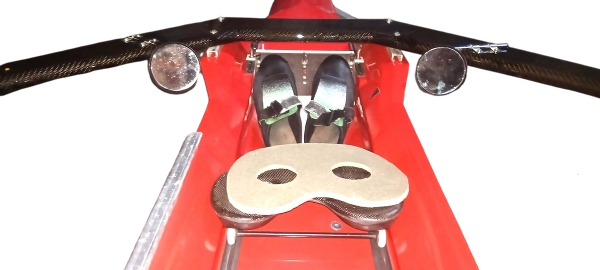
When looking over the shoulder becomes difficult, mirrors can offer a solution. Mirrors come in three variations as shown below: a cap mirror, mirror glasses, or boat-mounted mirrors.
Steering
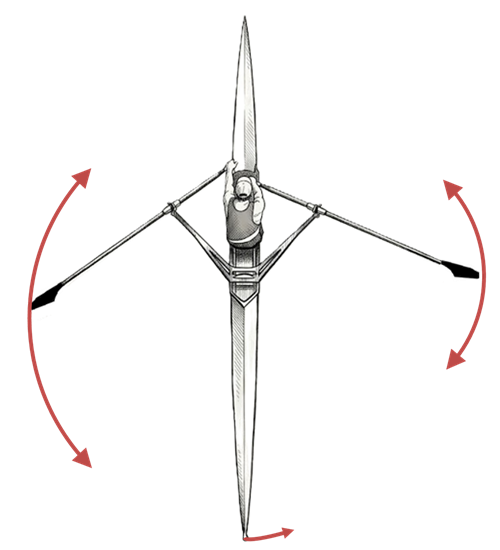
Steering the boat is done by taking a shorter stroke with one of the two handles. The blade on the side of the longer stroke will drive more than the other side, causing the boat to turn. When a scull boat veers toward port, the  Right handle to the hip fault is almost always the cause.
Related faults and drills
 |
Not checking the course |
 |
Look-around drill (coxless) |
 |
Rhythm |
This article was translated automatically and is provided to you for free. You are most welcome to improve it!