


|
|
Providing guidance |

Classic guidance (What to do)
With a classic guidance, the rower is told or asked what to do differently. The emphasis here is on what needs to be done: the what. For example, the question “Could you row a stretch without touching the water during the recover?” can still be executed by many rowers. The question “Could you row a stretch without rushing your slide?”, however, is a different story—that doesn't really work well. The core question here, of course, is why this execution is so difficult for the rower.

Every cognitive guidance enters the prefrontal cortex (understanding). However, motor functions are executed by a different section in the back of the brain. The rower will therefore have to translate the understood instruction into how to move and what they should feel, hear, and/or see. Such a question or instruction places quite a few demands on the rower: they need to know which movement is intended, be able to translate this 'knowing' into the correct movements, and actually execute it. They must also determine for themselves how to perceive whether the movement is performed correctly or incorrectly. Only a limited number of motorically gifted rowers are able to deal with this effectively. As a result, this approach often does not work very well.
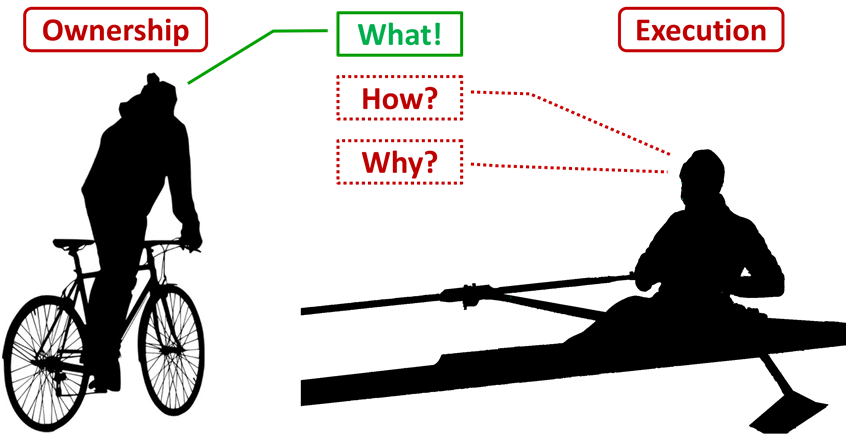
Classic approach: the coach/instructor tells what the rower should do.
The rower must discover for themselves how to do it and why they should do it.
When the why is omitted, the rower is expected to either obey passively or figure out for themselves why it is useful to do it that way.
In this option, the coach/instructor gives cognitive guidance. They tell the rower what to do differently, but not how to do it. The rower—and this is typical of this option—must make the translation themselves to how they should move, why they should move that way, and how to verify that they are performing the movement correctly. See also  Motivation (why) and focus (what).
Rowing rule (cybernetic)
When giving a cybernetic rowing rule, feedback provided by the boat, blade, and/or oars is used to help the rower learn the correct movement. This works best in small boats: single scull, C1, and pair. A rowing rule is given to the rower by the coach/instructor and helps improve boat control. The rowing rule consists of four fixed components and one optional component:
- motivate: naturally, it is important to motivate the rule.
- signal: a sensory cue showing how the rower with external focus can hear, see, or feel that the boat requires adjustment.
- act: the action the rower must subsequently perform.
- focus: the sensory cue showing how the rower can hear, see, or feel that the action was performed correctly.
- check: feedback for the rower on how well it is actually going, i.e., what percentage of strokes or how many consecutive strokes are executed properly.
An example.
Suppose every tap against the water costs 1/100th of a second. That adds up to one full second per kilometer, which is a waste. And that's not even considering rowing in rough waters with waves up to your armpits, where it costs much more (motivate). Therefore, we are going to do the following.
If you see that your blade is resting on the water after the extraction or hear it tapping against the water during the recover (signal), push your handles down onto your lap after the extraction to expand the clearance (act). Make sure your handles keep moving and that you feel your lap with your hands (focus).
On the way back: If you tap the water once every 2 strokes, you row 1:2. At five strokes, 1:5, and at 12 strokes, 1:12. How economically are you rowing? Try to improve it and report your score to your coach after practice (check).
Another example.
I notice your single scull is constantly leaning to port. That is inefficient, because it leads to a messy port-side extraction which causes the boat to off-track to port (motivate). That happens because you aren't pressing your left handle down properly. Therefore, we are going to do the following.
If you see your scull leaning to port (signal), press your left handle down properly after the extraction so that both handles move down equally far (act). Make sure that both handles move down exactly together and to the same level (focus).
On the way back: How many consecutive strokes can you keep your scull level? Whenever it leans to port, the counter resets to zero. Try to improve this and tell your coach your stroke count after training (check).
Motor skill cue
There are two different techniques for a motor skill cue: a Sensory guidance or a Motor analogy.
Sensory guidance
A sensory cue is a shortened form of a rowing rule where the boat itself plays no role. It guides the rower to use sensory feedback and gain focus. The coach/instructor points out what the rower should feel, hear, or see to execute the movement correctly. For example, instead of ”Keep your hands together!”, the coach asks: "Can you touch the palm of your left hand with the knuckles of your right hand during both the drive and the recover?" Another example to prevent rowers from rushing the slide too early: "Can you delay rushing until you feel the tendons under your knees pulling?"
It is preferable to use external focus here. External focus targets the outcome of the movement made by the rower. The coach/instructor refers to the foot stretcher, handles, blades, or the boat. If external focus is not possible, internal focus (what the body does) is a valid alternative. Providing external focus (the outcome of the movement) is superior to internal focus (body positioning), and having internal focus is still better than having no focus at all.
Motor analogy
A motor analogy provides an analogy for a physical movement. For example, instead of “Can you reach further at the catch?”, the rower is asked: “Imagine you are opening a set of double French doors. Can you push them open a bit wider?”
 |
Using a drill |
 |
Motivation and focus |
This article was translated automatically and is provided to you for free. You are most welcome to improve it!